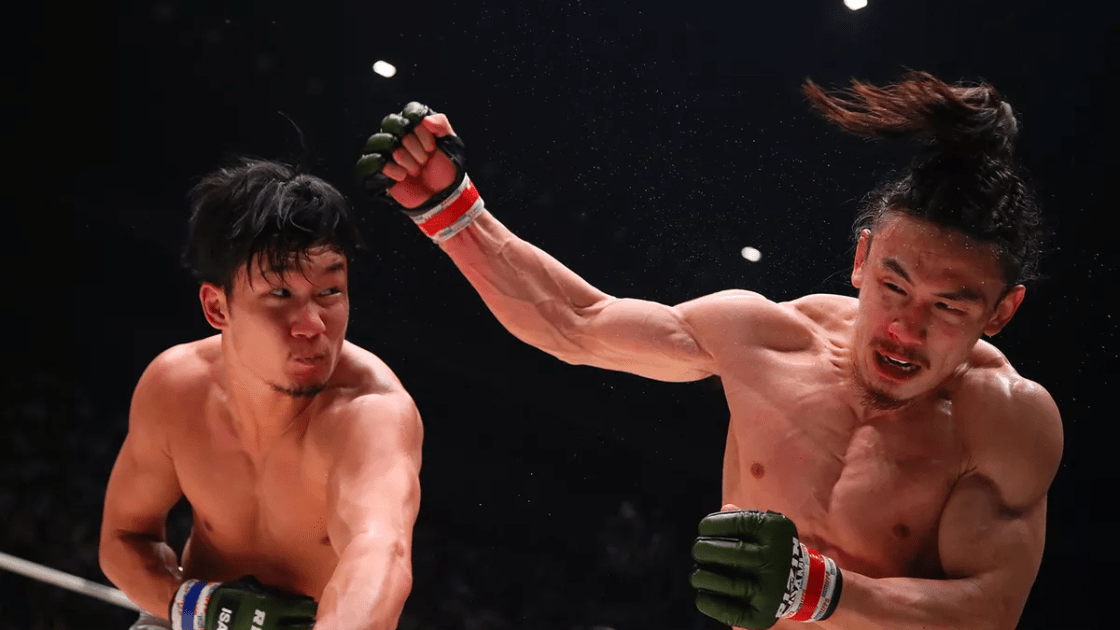
On Thursday, RIZIN finished off 2020 in mixed martial arts with its annual New Year’s Eve show from the Saitama Super Arena, the signature event of every Japanese combat sport season. It came through on every expectation of entertainment, and the great Kyoji Horiguchi capped things off by avenging last year’s defeat against Kai Asakura with a stunning first-round KO to once again win the promotion’s bantamweight title.
I’ll have more this week on Horiguchi, who I think deserves to finally be appreciated as one of the world’s pound-for-pound best. But first, I’m starting off 2021 by taking a look at three fighters outside the main event who had big moments on Thursday. Happy New Year!
Kai Asakura has become the breakout star of his family, and it’s easy to see why. His fighting style is tremendously appealing: he’s a whirling dervish of speed, power and fury, who is seemingly going for the kill from the second the bell rings. Even his defeats, like the one he absorbed against Horiguchi on New Year’s Eve, are very entertaining. He leapt in recklessly for a flying knee against one of the world’s best, and had his lights blasted out.
But when I watched RIZIN 26 on Friday morning, I was suddenly confronted with a question I had not considered before. What if Mikuru Asakura, Kai’s less-heralded older brother, actually ends up becoming the better fighter long-term?
There’s no question who the bigger name is right now. Kai is the main-eventer. He’s the action machine. He’s one of only three men to ever beat Horiguchi, one of the best pound-for-pound fighters on Earth, and he holds a win over Manel Kape, whom I suspect we’ll soon see very high in the UFC flyweight rankings himself. In a hypothetical world where the Asakura brothers are in the UFC themselves, you could easily see Kai in the top 10 at 125. Mikuru, at featherweight, would be deep in the shuffle.
But the two brothers accomplish their business completely different ways. While Kai is all-action, Mikuru is cerebral. Kai is more physically gifted, but he has a lot of swashbuckler in him – we saw this week how that can leave him open to getting knocked out by a top-level fighter. Two consecutive New Year’s Eve main events have ended with Kai Asakura out on the canvas. His seems like the kind of fighting style that can burn brightly but not for quite as long. But Mikuru looks like he’s getting better, and at 28 years old, he might be built to last.
Mikuru Asakura isn’t nearly as overtly aggressive in the ring as Kai, although they come from the same wild street-fighting background. Instead, he’s developed into an extremely sharp counter-striker, one who’s perfectly happy and comfortable playing the range game and waiting for his moment. He did that Thursday against former Deep champion Satoshi Yamasu, who wasn’t in the fight for a second.
For his part, Yamasu played right into Asakura’s hands. Yamasu showed Asakura’s power little respect in the early goings, attempting to quickly close the gap and put the pressure on him. It became apparent very quickly that Yamasu needed to be careful about how he approached, or otherwise he was going to get removed from consciousness. Asakura patiently felt his opponent out, and then struck like a cobra: the crowd favorite signaled that trouble was coming with a hard overhand left late in the first, before blasting Yamasu with a left high kick and curling him into a ball with a right hook that ended the fight.
It was a marvelous bounce-back performance for Asakura, who was rebounding from a very competitive decision defeat to top featherweight Yutaka Saito last month. And seeing him perform like this, so calm and in-control but so offensively potent, begs the question: what if we were giving all our attention to the wrong Asakura brother?
Mikuru showed against Saito that he still has some work to do to convincingly beat the best 145-pounders – although I thought he had an argument to win the decision in that fight – but at 28 years old, he still has plenty of time and room to grow. And every time he steps in there, we see that he has a smart approach and tremendous talent of his own. His style might be one that ages better than his brother’s. Kai fights with a recklessness that can bite him, while Mikuru doesn’t have that problem. I think there are big, big things to come for him.
Who says you can’t teach an old dog new tricks? Ayaka Hamasaki is 38 years old, has been fighting professionally for over a decade, and if she retired today, she’d be one of the frontrunners for the title of greatest atomweight fighter of all time. But that isn’t keeping Hamasaki from adding new things to her arsenal.
According to RIZIN English commentator Joe Ferraro, Hamasaki started to experiment with a unique leg-scissors choke a couple of months ago, as she trained for her atomweight title fight against wrestling specialist Miyuu Yamamoto. It’s the kind of submission you never see attempted, much less executed, in mixed martial arts.
So when Yamamoto took Hamasaki down early in round one, what do you think happened?
As I said before, Hamasaki could retire today and leave a legacy as one of the best women’s MMA fighters of all time. The fact that she’s still hungry enough to continue adding new things to her arsenal is very commendable, and the fact that she could get a finish in a championship fight with something so unorthodox just further illustrates her greatness. It’s another highlight on a reel that’s filled with excellent submissions, and it’s made her a two-time RIZIN champion.
Hamasaki was a really bad matchup for Yamamoto to start with. The 46-year-old former world wrestling champion has had a much better transition to mixed martial arts than anyone could have anticipated, but her one path to victory lay in taking Hamasaki down and controlling her, a strategy that would put herself directly in the danger zone of Hamasaki’s submissions.
That fear was realized almost immediately. Hamasaki was working the second her backside touched the mat, threatening with a kimura before transitioning into the headscissor that ended the fight. You don’t mess around with Ayaka Hamasaki on the ground if you’re smart, but it was a necessary evil for Yamamoto to have a chance in the fight. She paid for it.
Hamasaki is once again a world champion as she approaches her 40s, and has further cemented her place as one of the world’s best atomweights. UFC president Dana White has made some noise in recent months about being interested in adding a 105-pound division – if he’s smart, Hamasaki will be one of the first women he targets. If so, the brightest days of her career may still be ahead of her, and that’s saying something.
One of the forgotten talents on the RIZIN roster is flyweight Naoki Inoue. A karate black belt with a big-time submission acumen, Inoue was 10-0 and just a few days past his 20th birthday when he debuted in the UFC in 2017, going 1-1 before being caught in the flyweight purge of 2018. He soon returned to his homeland, making his RIZIN debut in January. He turned 23 in June – at an age when most MMA fighters are just starting their careers, he has 17 pro fights and experience at the very highest level of the sport.
Still, few of his 15 victories were as impressive as the one he scored on New Year’s Eve. Facing Yuki Motoya, a respected veteran who entered with a 26-8 record against a group of tough names, Inoue caught his opponent in a rear-naked choke just three minutes into the first round to elevate himself big-time in RIZIN’s bantamweight rankings.
The finish was made all the better by the fact that English color commentator Frank Trigg – who sounded like he was talking through two tin cans tied together with a piece of string – insisted multiple times during the leadup to the fight that Motoya would, in no uncertain terms, “win the ground game.”
As you know by this point of the recap, he, uh, didn’t. Inoue did a brilliant job the second the fight hit the mat, rolling through to take Motoya’s back on an early scramble and setting himself up to grab the choke. It was a fantastic piece of grappling from Inoue, and to me it was one of the standout moments on a very entertaining show.
And it makes you wonder: how much longer is it going to be until Inoue gets another opportunity at the UFC? He’s got a very nice skillset that you could see playing at a high level: he’s quick and moves well on the feet, he’s relatively tall and rangy for the flyweight division – he cut down to 125 in his first stint in the UFC, and you’d figure he’d return there – and he displayed how slick his grappling is on Thursday. He was the victim of some real bullshit the first time around, as his performance in the Octagon in no way merited him losing his job.
Naoki Inoue still has many, many years to be a factor in RIZIN, the UFC, or wherever he chooses to go. Again, he’s still just 23. At some point, this guy is going to be fighting for championships – and that time may come sooner than we expected.
 The Big Fight