Another fight weekend is in the books. UFC 269 finished off 2021’s pay-per-view schedule in a way no one anticipated, taking a spot as one of the best and most memorable shows of the year. In the main event, Charles Oliveira overcame a slew of doubters to come back from early adversity and finish Dustin Poirier in the third round, cementing his claim as the world’s top lightweight. That wasn’t even the surprise of the night: in one of the single greatest upsets in UFC history, +640 underdog Julianna Pena stunned Amanda Nunes to take her women’s bantamweight title by second-round submission.
I’ll have more on both fights this week. But for now, as usual, here’s a look at three fighters outside the main event who boosted their stock at UFC 269.
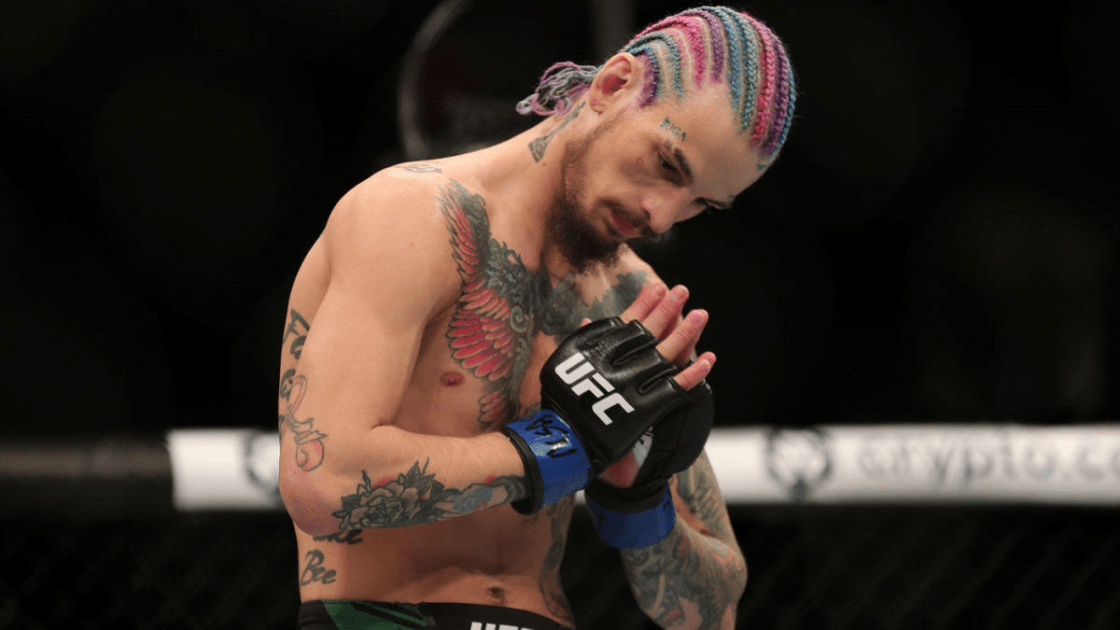
So, what the hell do we make of Sean O’Malley? Is he a future champion? Is he just an entertaining sideshow? Should we take him seriously? Does he want to be one of the best of the world or does he just want social media clout? I don’t know any of the answers to these questions yet. But what I do know is that when he’s in the cage, he’s a blast to watch.
O’Malley’s burgeoning hype has not been impacted much by his Aug. 2020 loss to Marlon Vera, where O’Malley’s little baby chicken legs failed him and he was finished by TKO in the first round. O’Malley’s last five wins have been knockouts, and if nothing else, he’s proven that there are few fighters on his level as pure range boxers at the bantamweight division.
O’Malley’s technique is beautifully clean, and opponent Raulian Paiva – formerly a ranked flyweight who moved up to 135 after a bad weight miss at 125 – found himself in over his head. O’Malley is a sniper at boxing range, and when he sensed weakness, he moved in for the kill. O’Malley’s finishing combo was one of the best you’ll see all year, combining speed, power, accuracy and a seamless mixing of targets. If it was anyone else, you’d say it was another key highlight on a young fighter’s rise towards championship contention. But with Sean O’Malley, the question is whether that’s even what he wants.
O’Malley has been open with the fact that he feels underpaid. That’s true for all UFC fighters, but more true than most for O’Malley. The colorful-haired, face-tatted “Suga” Sean has developed himself a nice following over the past few years – over 2 million followers on Instagram – and is one of the few UFC fighters to have developed his own actual mainstream notoriety outside the MMA bubble. People who aren’t normally big fans of MMA are interested in Sean O’Malley. Even the fighters he beats become bigger stars – the previously-unknown Kris Moutinho, after toughing through a crazy beating from O’Malley several months ago, received tens of thousands of new Instagram followers.
O’Malley’s approach to this has been fascinating. While almost every MMA fighter wants to climb the ladder, fight the best and compete for championships, O’Malley doesn’t feel like he’s paid well enough for that kind of effort. He’s not searching for main events and not calling out fighters higher than him on the totem pole. He’s made it quite clear that he’s fine just styling on beatable opponents, fighting out his contract in the hopes that he can cash in off his notoriety and make big money.
It may pay off. It’s much too soon to say. But we’ve almost never seen a fighter on the way up use this type of tactic, especially so openly. And the fact that it’s someone like Sean O’Malley makes the future that much more interesting. O’Malley has all the pieces to be a major star for the UFC, but still early on in his career, he finds himself somewhat at odds with the company. O’Malley may not need the UFC to do well for himself, but the UFC may end up needing him. And if O’Malley keeps turning in performances like this one, that need will grow ever greater.
The UFC’s funnest, most marketable personality isn’t being marketed. He isn’t a champion, anywhere close to it, or even ranked at all. He’s Tai Tuivasa, the fun-loving, beer-chugging Australian heavyweight knockout machine who’s on the run of his career, and is rapidly becoming a major fan favorite.
There are many fighters that are much, much better than Tuivasa, and many that I’ve been a fan of for much longer. But when Tuivasa wins, no one leaves me grinning like an idiot harder. Tuivasa has a proven formula for getting over with any crowd: dance his way to the cage to a popular, girly song (on Saturday it was Barbie Girl; against Greg Hardy in July, it was Wannabe by Spice Girls), send his opponent to the Shadow Realm, then chug a beer out of a shoe.
On Saturday night, his unfortunate victim was beefy Brazilian Augusto Sakai, who became the first ranked fighter Tuivasa had beaten in three and a half years. Tuivasa backed Sakai up to the fence in the opening seconds of the second round, ripped off a thunderous combination, and left the unconscious Sakai folded up like an origami crane.
Then, the beer bash. It was over when Stone Cold Steve Austin was doing it in 1999, and it’s still over today.
And by all accounts, Tuivasa really is that fun of a guy and that much of a party animal in real life. But the highlights and the hilarious celebrations shouldn’t cause one to lose sight of the genuine, significant improvements Tuivasa has made over the last three years. A former pro kickboxer, Tuivasa reached the top 10 early in his UFC career, but faltered when he faced higher-level competition, especially fighters who could grapple in any way, shape or form – the plodding Sergey Spivak notably took Tuivasa down six times in just a round and a half before finishing him with an arm-triangle choke in Oct. 2019.
Perilously close to losing his spot in the UFC, Tuivasa has now roared back with four straight resounding KO wins. Tuivasa has always had truly crunching knockout power that stands out even in the land of the giants, but training with Daniel Cormier at American Kickboxing Academy – a step Tuivasa took after the loss to Spivak – has apparently paid off some. Tuivasa will likely never be a comfortable grappler, but I was very impressed with the work he did in the clinch against Sakai. Sakai isn’t a huge threat to take Tuivasa down, but Tuivasa seemed perfectly comfortable in that area on Saturday, and did extremely well creating just enough space to rip off big combinations out of the clinch before Sakai was able to re-clinch.
It’s these small, gradual improvements that are going to keep Tuivasa moving upward and have elevated his potential, augmenting his monstrous punching pop. But the “shoey” gimmick is going to prove to be just as much of a boost to his career as this actual, tangible fighting progress. Tai Tuivasa has become a fighter fans tune in for. That’s worth as much as quite a few wins on its own.
On the women’s side, UFC 269 will always be remembered for Julianna Pena’s stunning rear-naked choke victory over Amanda Nunes, quite possibly the biggest upset in the history of women’s MMA and the biggest in the UFC period in a very long time. But in the other women’s fight on the card, we saw a potential future star at 125 announce her presence.
I’ve written before on this blog about my enthusiasm for Miranda Maverick, one of the UFC’s most talented young female fighters, and one who I think has a bright future in the flyweight division. But on Saturday, Maverick got turned into a turnstile. Maverick ran into a fighter who is younger and more talented, and got owned. Now, Erin Blanchfield is stealing her shine.
A 22-year-old from North Jersey, Blanchfield knew early on this is what she wanted to do. She’s been grappling since she was a child, and decided she wanted to one day become a professional mixed martial artist by the time she was 12. MMA is a young sport, but women’s MMA is even younger. It was Gina Carano who truly put women’s MMA on the map in the late 2000s; Ronda Rousey‘s run on top, which turned many young women onto the sport, didn’t happen until several years later. Blanchfield is one of the first generation of girls who could actually access women’s MMA on TV growing up, and make that their childhood dream.
Blanchfield has wasted no time. She made her pro debut at 18, was fighting future UFC fighters in Invicta while still in her teens, and in her early 20s is already a viable fighter in the UFC flyweight division. Blanchfield is a smothering grappler who has now won both of her UFC fights by dominating her opponent on the mat. Blanchfield controlled Sarah Alpar for nearly 10 full minutes in September, earning a couple of 30-25 scorecards for her efforts; she followed by taking Maverick down seven times on Saturday, for 12 minutes of control time on the ground.
Maverick, a still a very promising and athletic young talent, seemed to slightly have the better of Blanchfield on the feet, but any advantage she might have had there was completely nullified by Blanchfield’s grappling domination. Time will tell whether Blanchfield has the well-rounded game required to be a true title contender, but the fact that she has this good of a bread-and-butter this young is very promising.
Flyweight is one of the most cleared-out divisions in the UFC, and there are whispers that champion Valentina Shevchenko could be eyeing the bantamweight title now that Pena – whom Shevchenko has beaten at 135 – now holds the belt. But as we just saw, no champion, no matter how dominant, is invincible. And with a young talent like Blanchfield on the way up, there’s no reason why she can’t be a factor. It’s the same question I ask quite a bit: if Erin Blanchfield is this good at 22, how good is she going to be at 27?
 The Big Fight