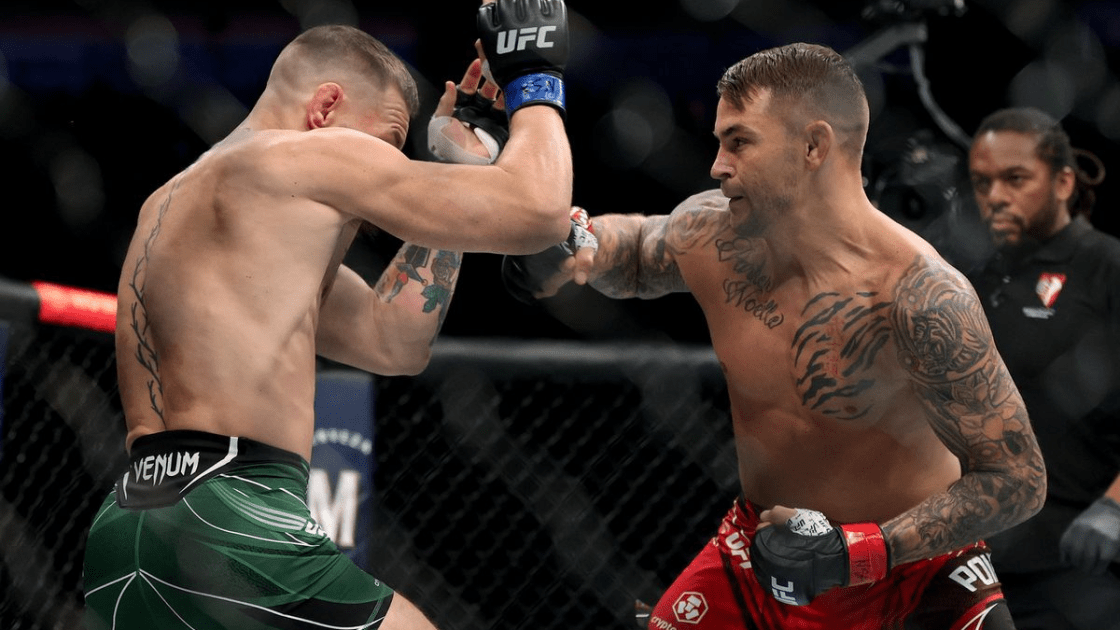
I’ve said it before many times on this blog: there is nothing more dangerous in the sport of mixed martial arts than a grizzled young vet. A fighter who starts early, makes it to the big show at a young age, and takes their lumps: gathering experience at the highest level of the sport while maturing into their physical prime.
Think Charles Oliveira. Think Max Holloway. Think Robbie Lawler. And think Dustin Poirier, who has arrived as one of the world’s biggest MMA superstars at just the right time.
Oliveira was 20 when he debuted with the UFC, and won his first world title at 31. Holloway debuted at 20, and at 29 may have arrived at the best version of himself. Lawler also debuted at 20, and after an incredibly winding road became a UFC champion at 32.
Then there’s Poirier. “The Diamond” debuted in the UFC in 2011, at the age of 21 – so old! – and now, at 32 years old, has developed into one of the UFC’s best pound-for-pound fighters and perhaps the top lightweight in the world, with out without the belt. This goes well beyond the rivalry with Conor McGregor, easily the most highly watched and well-publicized bouts of Poirier’s career. Poirier has been killing it for a long time – and we’ve gotten to see him grow up before our eyes.
From his earliest days as a talented young featherweight emerging onto the scene in the WEC, a few things have been constant with Poirier’s game: a potent, boxing-heavy approach, punching power, an impressive chin, and a willingness to give and take in the pocket. Poirier has improved upon and refined these tools to become one of the sport’s best strikers, forging his fighting style against arguably the toughest strength of schedule in MMA.
Poirier has always had a bit of brawler and swashbuckler in him – older fans might remember his Fight of the Year war with Chan Sung Jung in 2012, when he was still just 23 – and that ethos is still there with him. Poirier will always be willing to take a punch to land a punch, trusting that his strong chin and great hands will allow him to do better work in the pocket.
His comfort level with a dangerous striker in his face is almost unmatched. Poirier has been in so many battles with so many great fighters that he’s developed into one of the coolest customers in the business – he’s willing to amp up the energy and get into a slugfest, but he always keeps his head in the game. Most impressively, Poirier is as good at reading and reacting in the middle of an exchange as anyone I’ve ever seen: these split-second course corrections during combinations that allow him to put on unceasing pressure. Think what he did to Justin Gaethje, one of the baddest and most violent men in the lightweight division. His hand-eye coordination is otherworldly.
He may lack the explosive one-shot murder power of a McGregor, but Poirier’s knockouts are often even more impressive. They’re not single blows out of nowhere. They’re Poirier dragging his helpless opponent into quicksand, battering them with an unceasing series of punches that slowly break their bodies and minds.
But beyond that, Poirier has gradually evolved into a strong defensive fighter when he wants to be defensive, refining the technique some refer to as the “hillbilly shoulder roll” into a foundation block of his fighting style. This stood out especially when comparing between the three McGregor fights: in the latter two, Poirier was so much better at avoiding getting hit at range than he was at 2014. Part of that was that McGregor wasn’t as capable at covering ground quickly, but part of that is how well Poirier has learned how to leverage his body to blunt the impact of incoming blows.
Over the last several years, we’ve seen Poirier reinvent his striking approach in some key ways, opening himself up for success. We’ve seen him lean on calf kicks more in certain situations. We’ve seen how he’s adjusted his defensive posture to make sure he’s not at risk when he’s not choosing to put himself at risk. And we’ve seen the impact of his incredible experience: he’s become tremendous at putting together and executing a winning gameplan. The finest recent example of this, of course, is the second McGregor fight: Poirier started conservatively early, focused on staying away from McGregor’s left hand and making investments with the calf kick, sacrificing the first round to set himself up to turn the tide later.
There’s really nothing left that can awe Dustin Poirier in the cage. He’s been in there with everyone, seen it all, won and lost in almost every way you can. (I haven’t even mentioned the fact that he knows how to grapple.) What’s left is a fighter with a lifetime’s worth of skill and experience fully harnessed and honed to a razor point. And very soon, he’s going to be the world champion.
 The Big Fight