Another fight weekend is in the books. This past week was the most stuffed week of fights we’ve had all year, with ONE debuting on TNT on Wednesday night, a big Bellator show on Friday, and a UFC card on ABC on Saturday afternoon. And after dozens of high-level fights, the slate was capped off when Marvin Vettori added another notch to his UFC middleweight resume by sending Kevin Holland to his second straight demoralizing decision defeat.
I’ll have more on the current status of the UFC middleweight division this week. But, as usual, here’s a look at three fighters outside the main event who boosted their stock in a big way:
Quick trivia question: which fighter currently owns the longest win streak in the sport’s most dangerous shark tank, the UFC featherweight division? Is it champion Alexander Volkanovski? Is it the unstoppable force known as Max Holloway? Is it Zabit Magomedsharipov, who hasn’t lost a pro bout since 2013?
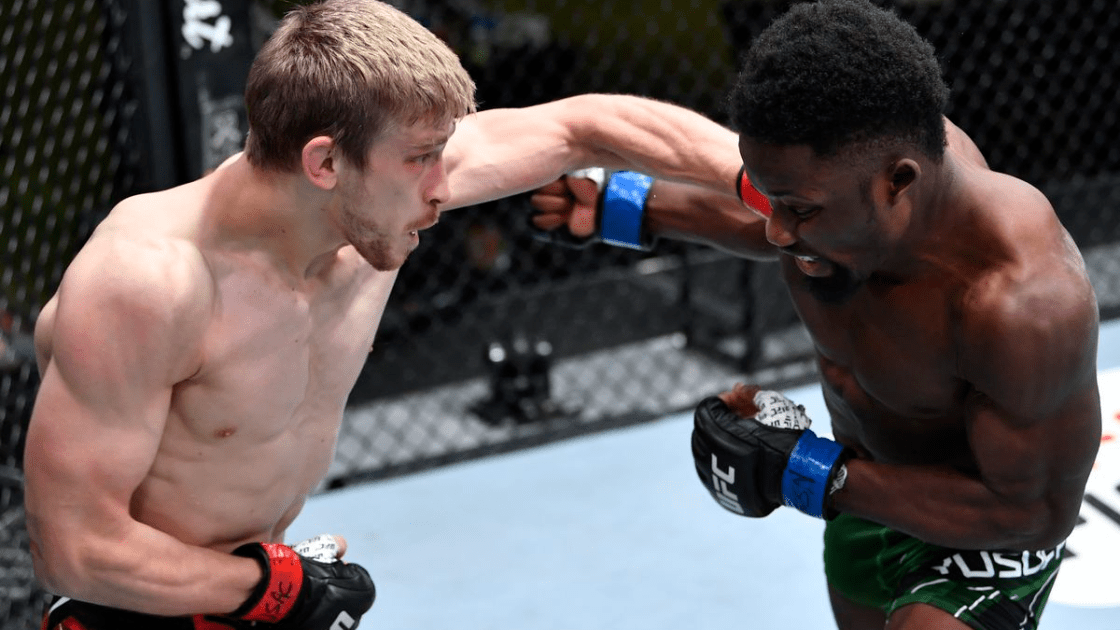
None of the above. The answer is actually 27-year-old Englishman Arnold Allen, who has emerged over the last several years as one of the top prospects in the UFC’s deepest division. Allen reached the top 10 of the 145-pound rankings last year after a fantastically impressive run to start his UFC career – including a very sharp performance in a win over former superstar Gilbert Melendez – and on Saturday, he ran that win streak to eight with a unanimous decision win over another highly regarded young talent, Sodiq Yusuff.
Allen-Yusuff was an extremely intriguing matchup between two rising stars in their 20s who go about their business in very different manners. Yusuff is aggressive, dynamic, athletic and pushes the pace. Allen, on the other hand, thrives off his defense. He’s extremely technically sound, showcases great footwork and elusiveness, and is exceptional at moving in and out of range.
This clash of styles was just as captivating as expected. And in the end, Yusuff had his moments: although Yusuff struggled as most do to ever pin Allen down anywhere, he actually outlanded the Brit by a very large clip, 79-26 on total strikes.
Now, how on Earth do you get outlanded 79-26, in a fight largely contested on the feet, and still win? You make your shots count. Allen hurt Yusuff badly in each of the first two rounds, first rocking him with a short left hand in the first round, then putting him on wobbly legs with a head kick in the second – if Allen hadn’t slipped while throwing the kick, he might have taken Yusuff out.
And throughout the bout, Allen once again displayed his exceptional footwork and movement, avoiding taking any real significant damage from Yusuff despite the statistical deficit in strikes. He fights with the craftiness of a seasoned vet in his mid-30s, and it keeps resulting in the same outcome: Arnold Allen, by unanimous decision.
The UFC has done a very nice job building Allen up, pushing him steadily without throwing him too far into the deep end. He debuted in the Octagon at 21 and has received healthy steps up in competition at every stage: all of his fights have meaningfully challenged his game in different ways, but they’ve all been achievable. Now, he’s finally arrived as a real contender. The real fun is about to begin.
A little more than a minute into Mackenzie Dern’s tilt with top-five ranked Nina Nunes (formerly Ansaroff) on Saturday afternoon, Dern sat Nunes down with a single leg takedown. It was at that moment that the rest of the fight became a simple formality.
It was obvious from the second the fight hit the mat that Mackenzie Dern was going for the arm. There was not a single thing Nunes could do about it.
Dern cut through Nunes on the ground like a hot knife through butter. It’s exactly what we’ve come to expect from her. At 28 years old, Dern is one of the most accomplished female Brazilian jiu-jitsu competitors in the sport’s history: the daughter of decorated grappler Wellington “Megaton” Dias, she’s a former ADCC gold medalist who’s won every BJJ competition you can name.
That grappling pedigree made Dern one of the hottest prospects in the strawweight division when she arrived in the UFC in 2018. And over the past year – after she missed much of 2018 and 19 for the birth of her first child, and after she was boxed up by Amanda Ribas for the first defeat of her pro career – we’ve seen Dern exploit her grappling advantage much more ruthlessly.
The results: three first-round submission wins in her last four fights, with the only exception being a decision victory over Virna Jandiroba, one of the few fighters in the division with the BJJ skills to possibly make her sweat on the ground. As is MMA tradition, grappler + grappler = kickboxing. Dern won a very entertaining, if not particularly technical, brawl.
Dern will once again, at some point, have to prove that she can get it done against a fighter like Ribas, a good striker who will make her work hard to get her down. There are plenty of those tests waiting in the upper reaches of the strawweight division, a fantastically deep group of fighters. But when Mackenzie Dern puts you on the ground, the result is a fait accompli. She’s rapidly become appointment viewing.
I already touched on ONE flyweight champion Adriano Moraes’ stunning knockout win over 125-pound GOAT Demetrious “Mighty Mouse” Johnson last week, as part of a larger-focused column on what it signified about the strength of worldwide MMA as a whole. But we really need to reckon with just what it means for Moraes specifically.
Quite simply, this win enters Moraes – who has been the ace of the ONE flyweight division for years, but whose resume has lacked any wins with real name recognition. Until Wednesday, Moraes’ most well-known victim was probably a past-his-peak Yasuhiro Urushitani, a former Shooto champion who was one of the most well-regarded 125-pounders in the world during the pre-UFC era, and went 0-2 in a brief stint in the Octagon in the early days of the UFC flyweight division. That’s how you enter a title defense as a massive underdog. So, you want to beef up your resume: how about becoming the first man ever to finish perhaps the greatest all-around fighter who ever lived?
Moraes’ calling card heading into Wednesday night was his legitimately marvelous jiu-jitsu skills, which have earned him a lot of acclaim throughout his career. When you watched him fight, it was obvious that he was pretty strong and could throw some leather, but those aspects of his game weren’t what was advertised.
But it’s how Moraes won against Johnson, dropping him with an uppercut, blasting him with a (legal) knee on the ground and putting him away with a flurry of punches. When one envisioned Moraes’ potential paths to victory before the fight, you figured that if he was going to win, it would be by either controlling the smaller Johnson on the ground or catching him in some submission. Instead, Moraes just knocked his ass out.
And it’s not as though Moraes isn’t a real flyweight – I saw the size difference overstated after the fight. Moraes has fought at 125 his whole career, and fought at 125 in ONE before they changed the weight cutting rules. He was bigger than Johnson, yes, but Johnson is just 5-foot-3 and has been the smaller man in basically every single fight of his career. Moraes was just the better fighter on Wednesday night.
It’s the kind of victory won can build a reputation and a legacy around. Johnson left the UFC still arguably the No. 1 flyweight in the world, and had done nothing to diminish that reputation in ONE, showing that he hadn’t lost even half a step in sweeping through the Flyweight Grand Prix in 2019. If this same fight happened in the UFC, Moraes would be at the top of every single flyweight ranking in existence.
Because it happened in ONE, however, the potential remains that Moraes may still not get the recognition he deserves. Don’t let that fool you. Adriano Moraes is now one of the world’s flyweight kings.
 The Big Fight