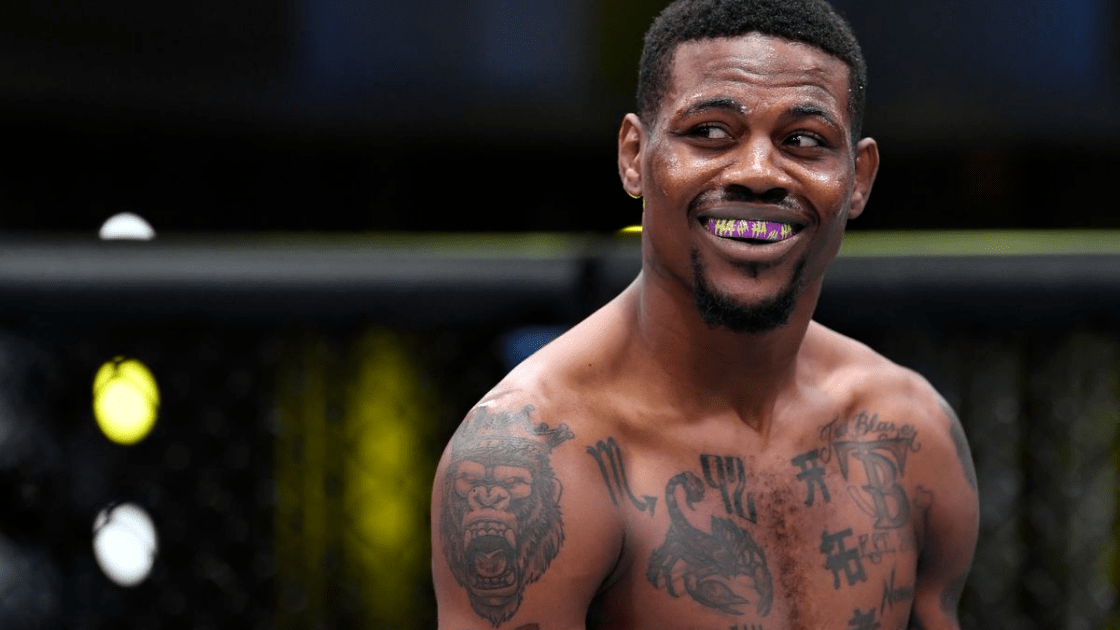
Budding middleweight star Kevin Holland entered his first career UFC main event on Saturday with an opportunity to turn the entire MMA world’s heads. Instead, he left the MMA world scratching them. Holland was summarily dominated by veteran gatekeeper Derek Brunson in a blowout unanimous decision, getting taken down six times and controlled on the ground for nearly 17 minutes of a 25-minute fight.
Holland had moments – he hurt Brunson during the biggest standup exchange of the fight in the second round, and won the fifth round after becoming the first fighter in Brunson’s long UFC career to take him down – but displayed either a shocking lack of urgency to go all-out for the win, or a lack of fight IQ and technical ability.
And with Holland’s hype train, which had surged to maximum speed after five straight smashing victories in 2020, crashing into the ditch, the focus became honed on Holland’s big mouth. Holland has always been knock for talking nonstop throughout his fights – it’s not really trash talk per se, more a running monologue of his inner thoughts that’s constantly spewed over the duration of a bout – and Saturday’s fight was no exception.
To most people, it was a sign that Holland hadn’t taken the fight seriously – or perhaps something even worse. The armchair psychologists were out in force. He self-sabotaged because he was afraid of success, some said. Others said that he had a full-on mental breakdown in the cage. UFC president Dana White even likened it to the infamous 1997 heavyweight boxing championship fight between Oliver McCall and Lennox Lewis, where a clearly mentally disturbed McCall refused to fight back, started crying in the ring, and wound up getting sent to a psych ward.
There is little doubt that Kevin Holland has the pure talent to be a UFC superstar. He’s long, athletic, punches with a sniper’s accuracy, has big one-punch pop, and has shown the kind of pure creativity that you see in the sport’s very best. But the Brunson fight showed very clearly that he needs something else to make it over the hump. Is it a new camp? Is it a new attitude? A new outlook on life? To shut the hell up and get serious? Does he need a sports psychologist?
Nah. He needs to learn how to defend takedowns. The only thing his unsuccessful fight with Brunson displayed was an issue that he had previously been able to work around: poor takedown defense that we had seen rear its head in previous fights. Holland is a fantastic striker – he might already be one of the UFC’s most effective – and his thrilling 2020 rise came mostly against fighters who couldn’t exploit that weakness.
Neither Anthony Hernandez or Charlie Ontiveros managed to last long enough to do much of anything against Holland. Joaquin Buckley is a boxer through and through. Darren Stewart is primarily a striker as well, but still took Holland down three times in his decision defeat. And Ronaldo “Jacare” Souza took Holland down twice in less than two minutes before Holland pulled a rabbit out of his hat by knocking him out from bottom position.
Holland is far from the first fighter to face Derek Brunson and get taken down a bunch. It’s one of the things Brunson’s best at, and he’s relied on it more and more during his excellent recent run: the Holland fight was his fourth straight landing multiple takedowns. Holland is long, wiry and skinny, and Brunson is a muscular powerhouse. And while we wanted to see Holland work harder to get up from the bottom, why don’t you let Derek Brunson take you down, and try to get back up?
We didn’t learn anything we didn’t already know – the Brunson fight just put this gaping hole in Holland’s game in sharper perspective, putting it on the radar less as a “potential pitfall” into more of a “fatal flaw” type territory. This wasn’t even the first time Holland had been taken down six times in a UFC fight: Gerald Meerschaert got him down six times in March 2019, in a fight Holland actually won. Thiago Santos, similarly a much larger, stronger fighter, took him down three times in Holland’s UFC debut and controlled him extensively. As previously mentioned, Stewart took him down three times last September. Jacare, Brendan Allen and Alessio Di Chirico have also landed multiple takedowns against Holland in the UFC.
But Holland’s running monologue, his class clown manner and his constant smile rankle some in defeat. To them, it’s a sign that he isn’t giving the sport the seriousness it deserves. To which I answer: who gives a shit? If it’s entertaining, isn’t that what matters? Kevin Holland talks all night no matter what happens. When he was winning, it was part of what made him a star in the making. Now that it happened in a loss, all of a sudden it’s a problem.
This is who Kevin Holland is. He’s a jokester who doesn’t have an off switch. It’s just now, all of a sudden, he’s built himself some hype. There are more expectations and more eyes. And with more eyes comes more criticism. But if Kevin Holland changes that part of himself, then you don’t have Kevin Holland anymore. You have a completely different fighter, perhaps for good, perhaps for ill.
Kevin Holland doesn’t need to change anything about himself to succeed in the UFC. He’s done pretty well as the jokester he is. He needs to change one thing, however: learn how to stop a takedown. Doing that is going to have more of a positive effect on his career than scowling and pretending to be serious.
 The Big Fight