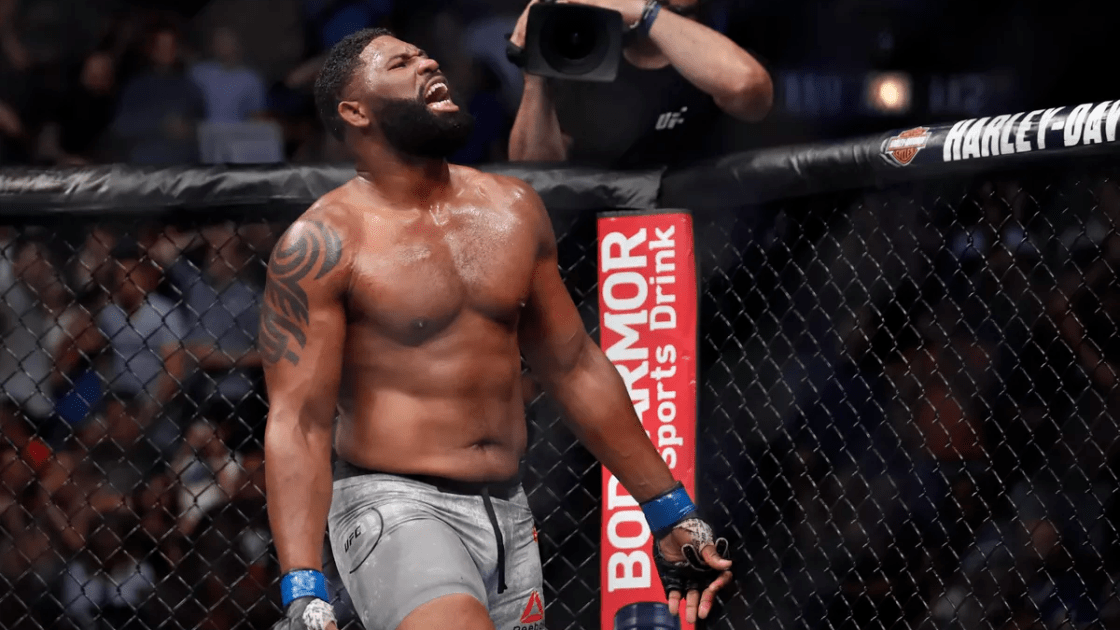
Another fight weekend is here, baby, and we love to see it. This weekend is typical of what we’re going to be getting pretty much every week until the start of April: a UFC card of varying quality, maybe a ONE or LFA show, and that’s usually going to be it. That’s life until Bellator and PFL start running regularly.
This week’s UFC Fight Night show, at least, has a few interesting matchups on it. So, as always, here’s a look at the three fights I’ll be watching closest on Saturday:
Curtis Blaydes vs. Derrick Lewis
It’s about goddamn time we get the heavyweight division really moving again. Curtis Blaydes and Derrick Lewis were originally meant to face off in the main event of a fight card on Nov. 28, only for Blaydes to test positive for COVID-19 the night before. It ended up being a one-fight show that lost its one fight. Devin Clark main-evented. It was arguably the most devoid-of-talent UFC card in history.
In between when this fight was supposed to happen and when it (fingers crossed) will actually happen, a few things have changed at the top. We now know that Stipe Miocic will for sure defend his heavyweight title next month against Francis Ngannou. We also know the winner will face Jon Jones, getting an immediate title shot on his move up from light heavyweight.
This seemed more or less likely three months ago, but it’s nice to have an actual official knowledge of what’s going to happen. We’ve also seen Alexander Volkov submit his name as a true top contender with a trouncing of Alistair Overeem earlier this month. It seems very conceivable that the winner of this fight could end up facing Volkov, if for no other reason than it’ll probably be well into 2022 when the Miocic-Ngannou-Jones situation fully shakes out. Matching these guys up with Volkov is an interesting prospect considering that Volkov’s only two UFC losses are to these two men – and he had chances to win both bouts. Of course, this is pure speculation. But the title implications of a potential rematch with Volkov, for either man, makes this fight so much more important.
Blaydes and Lewis have been floating around the top 5 at heavyweight for so long that I’m kind of surprised that they’ve never actually fought before. It’s a matchup between one of the best straight-line wrestlers in the UFC, against one of the most physically powerful anti-grapplers we’ve ever seen. Both guys have knockout power. Stylistically, it’s a very interesting matchup.
Blaydes is absolutely one of the very best heavyweights in the world, a dominating double-leg machine with some of the most brutalizing ground-and-pound in the sport. Overeem can tell you all about how not-fun it is to fight Blaydes, who turned his face into hamburger with elbows in 2018.
Blaydes’ highlight reel is filled with finishes just like that: he takes you down, plants you on your back, then unleashes some of the most vicious elbows in MMA until it’s all over. He knows exactly what he’s really good at, and implements it ruthlessly. Only one man has been able to stop him: Ngannou, who is responsible for both of the losses on Blaydes’ pro record.
There’s no shame in losing to Ngannou, a man of uncommon physical talents. But the physical talents of Derrick Lewis are pretty damn uncommon as well. Lewis has always been a bit of an enigma, one of the types of quirky characters that can seemingly only exist in mixed martial arts. But it cannot be denied that he is a freakishly strong human being, a trait that drove him to a heavyweight title shot against Cormier in 2018.
Lewis is a boxer who has never really shown any special skill in any grappling art. You can take Lewis down. The problem is, you might be on top of Derrick Lewis, and then he’ll just decide to stand up. When he makes that choice, it doesn’t matter if there’s a 250-pound man pressing all his body weight on top of him. Derrick Lewis will just stand the fuck up. And if you’re a grappler, what do you do when Derrick Lewis decides that grappling isn’t real?
Lewis’ last fight, against venerable Russian Alexey Oleinik in August, was a science experiment. What if we put Lewis in the cage against one of the most celebrated heavyweight grapplers in MMA history? Is it possible to neck crank a grizzly bear? The answer was no. Oleinik took him down, and he did in fact attempt to neck crank this grizzly bear. He seemed to have it pretty tight, too, but Lewis didn’t seem fazed at all. He waited it out until the round ended, then knocked Oleinik dead in the opening seconds of round two.
Lewis is a striker who isn’t even particularly technical on the feet. He’s just an old-fashioned swang n’ banger, and if he touches your chin with one of his massive paws, you’re usually screwed. But I feel like I don’t know exactly what to expect out of Lewis on Saturday – there have been rumors that he’s actually training other aspects of his game, and he’s made funny comments about wanting to outwrestle Blaydes to a decision win.
That’s probably not going to happen. But I view this as an experiment along the same lines as his fight with Oleinik. Much like how Japanese fight promoters spent years trying to figure out how much damage it was possible for Kazuyuki Fujita‘s iron skull to absorb, the UFC is again running a test on Lewis’ freakish physical qualities. We’ve found out that it’s impossible to neck crank him. But can a world-class ground-and-pounder hold him down long enough to elbow him to death? Blaydes is the guy to find this out.
In a five-round fight, it may ultimately come down to whose gas tank is better. Lewis’ has been questionable throughout his career, while Blaydes tired badly late in his five-rounder with Volkov in June – while he won anyway, it got him in some real trouble late. At the end of the day, it’s still heavyweight MMA. But if and when these guys get tired, who the hell knows what this fight looks like?
Blaydes has, for all his success in the UFC, never received a title shot: two KO losses to Ngannou, the only defeats of his career, made sure of that. Lewis got there in 2018, but Daniel Cormier just proved to be too good. The winner of this fight may end up in the perfect position to get his first, or second, look at the belt.
Ketlen Vieira vs. Yana Kunitskaya
As I’ve written about before, the dominance of champion Amanda Nunes has just about killed the women’s bantamweight division – we’re in a position right now where basically the only people at 135 qualified to get a shot at Nunes are people that she’s already beaten, in some cases multiple times. The division could desperately use some new blood. The co-main on Saturday could provide it.
In fact, people were just about ready to give Ketlen Vieira the next title shot all the way back in 2018, when she beat former title challenger Cat Zingano to really put herself on the map. At the time, she was 10-0, had won four straight in the UFC, and was looking like the next big thing. But instead of giving her a chance at the belt right away, they gave Vieira one final test: Mexican slugger Irene Aldana, an excellent boxer with heavy hands.
That, uh, didn’t go so well.
Since then, Vieira’s been working to regain her lost hype. She bounced back with a win over Sijara Eubanks and a win on Saturday should put her roughly where she was before she fought Aldana. Vieira mixes good cardio and pressure ability with a strong judo background – her judo takedowns are some of the best you’ll see in MMA – and a black belt in BJJ. She’s very capable of putting it on you for three rounds, unless of course, you can catch her on the chin.
That’s something Yana Kunitskaya is very capable of doing. Kunitskaya is in a similar position to Vieira career-wise: not long ago she had a promising run at the top halted by a knockout loss, in her case to Aspen Ladd in 2019. Formerly the Invicta bantamweight champion, Kunitskaya was brought into the UFC in 2018 as a challenger for featherweight knockout machine Cris Cyborg, and suffered the same fate as almost every woman Cyborg faces. She’s since established herself as a high-class 135er in the UFC, most recently rebounding from the Ladd loss with a unanimous decision over Julija Stoliarenko last year.
One of Kunitskaya’s biggest advantages at 135 has always been her strength and power: she cuts down big to get to 135, and at times has appeared physically much larger than her opponents in the cage. That’s allowed her to fight like a bully, controlling where the fight goes, dominating clinch positions and working opponents over with her strong Muay Thai ability. Things may be a lot more even in that respect against Vieira, who’s very good in the clinch herself. What happens up close will likely determine the fight.
There’s been no word on who will get the next chance at Nunes at 135 – for now, the double champ is tied up at 145, where she faces Megan Anderson in a couple weeks. This fight could go a long way towards setting future directions at bantamweight.
Andrei Arlovski vs. Tom Aspinall
The UFC has another very interesting heavyweight fight on Saturday, but this one a bit further down the totem pole. Unlike Blaydes-Lewis, this one actually involves a fighter who’s held the big gold belt. Andrei Arlovski is one of the last remaining active mixed martial artists who fought in the 20th century: his infamous debut KO loss to Viacheslav Datsik, a portly Russian neo-Nazi renowned in Internet MMA circles as one of the most severely mentally ill athletes in the sport’s history, happened in April 1999.
Needless to say, Arlovski’s career went up from there. Arlovski debuted in the UFC the next year and was a world champion by 2005, serving as one of the world’s top heavyweights throughout most of the decade. Arlovski mixed a high-level sambo background with well-developed striking and punching power, and his mouthpiece looked like werewolf fangs, which was pretty cool. He was a badass.
Arlovski left the UFC on a three-fight win streak in 2008 and hit the road, fighting basically everywhere you can name. He finally returned to the UFC in 2014, had a real nice win streak, got his ass kicked by Stipe Miocic, and has settled into a long-term role as an important gatekeeper for rising heavyweights. Even at the age of 42, Arlovski is crafty, experienced and skilled enough to win a decision against young fighters who don’t have it all put together. Just four months ago, Arlovski completely frustrated Tanner Boser, a 29-year-old Canadian who had built some hype off two straight quick KO wins, and won a unanimous decision.
Arlovski has become an important barrier for heavyweights trying to break out of the lower levels and into ranked territory. The next guy who will make the attempt is talented Brit Tom Aspinall, a 27-year-old who’s been dominant in two wins to start his Octagon career. I’ve been very vocally pro-Aspinall, whom I included in my list of five potential UFC breakout candidates in 2021. That list, uh, isn’t looking so great right now.
We’ll see if Aspinall can break the Statman curse. Aspinall has been a quick-finish specialist so far in his pro career, with none of his nine victories taking him longer than 1:35. Since a three-year hiatus from active competition between 2016-19, Aspinall is 4-0 with his fights averaging just over a minute in length. He looks in really good shape for a guy his size, and his striking looks very clean and powerful, but he’s never been dragged into the deep waters yet.
Arlovski, if nothing else, is likely going to make Aspinall work for it. And if Aspinall can blow the doors off the former champion like he has basically everyone else he’s faced in his career, we might really have something here. I’m looking forward to seeing if he can pull it off.
Honorable mention: Phil Hawes vs. Nassourdine Imavov, Alexey Oleinik vs. Chris Daukaus (neck crank city, baby!), Drakkar Klose vs. Luis “Violent Bob Ross” Pena
 The Big Fight