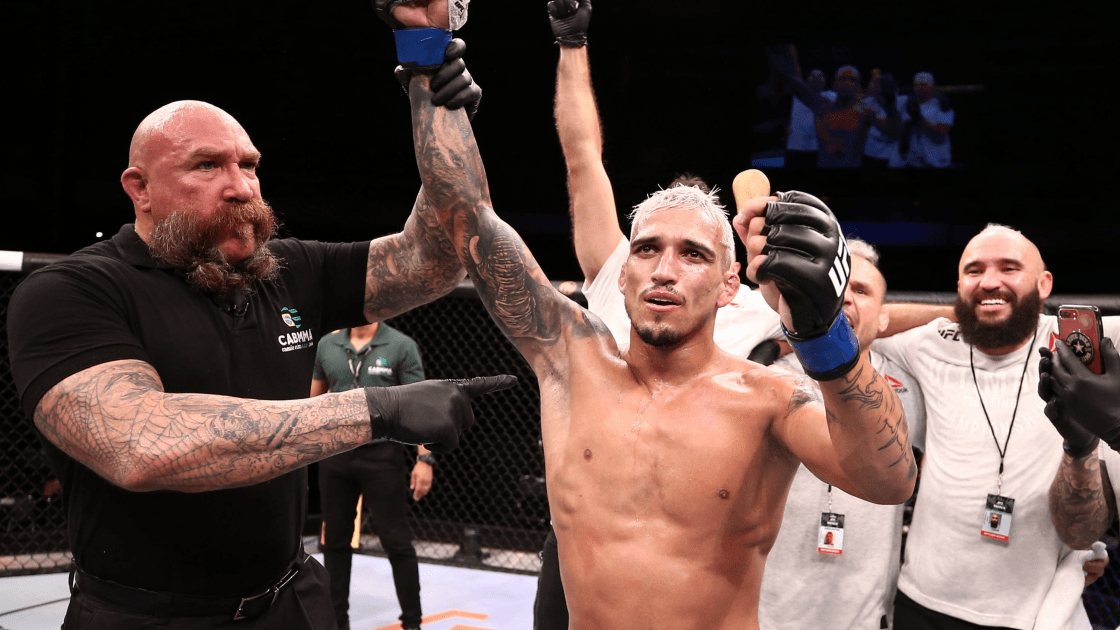
If you weren’t looking for it, Charles “Do Bronx” Oliveira‘s long rise to lightweight contendership was easy to miss.
Over 10 years and 28 Octagon appearances, Oliveira became a part of the fabric of the UFC, a guy who’s always present but you don’t always think about. For years, Oliveira was a talented featherweight renowned for possessing some of the most dangerous submission skills in the sport, but frequent weight misses and a series of losses to real stars – guys like Frankie Edgar, Anthony Pettis, Max Holloway, etc. – relegated him to the middle of the pack.
Until this March, Oliveira had headlined one UFC event in his decade-long career with the organization: a 2015 Fox Sports 1 card in Saskatoon, where Oliveira injured his neck trying to take Holloway down and the fight was stopped early in the first round.
This was Oliveira’s existence in the UFC for years and years. Oliveira became a welcome attraction when he’d pop up on a UFC show, but you didn’t always realize he was fighting until he was up next. He wasn’t a featured guy. He was a fun talent to watch, but a few well-known holes in his game – uncertain striking and an insufficient gas tank – meant that he was never going to be a true contender at 145.
It was easy to forget that Oliveira debuted in the UFC when he was just 20 years old, one of the youngest UFC fighters ever. It was easy to forget that a kid that young had been honing his skills, battling and testing some of the very best in the sport time and time again. It was easy to forget that he was only now entering his real prime.
On Saturday, Charles Oliveira completely dominated Tony Ferguson, one of the greatest lightweights in the mixed martial arts history and perhaps the greatest UFC fighter to never hold an undisputed world title, for three rounds to earn by far the biggest win of his 12-year pro career. In doing so, he might have put himself in line for the first championship opportunity of his long UFC tenure. And if you’ve been watching closely, it shouldn’t have come as a surprise.
After his struggles to make 145 pounds intensified over 2015 and 2016, Oliveira finally made the move to 155 in 2017. His rise to the top started on the Fight Pass prelims. He began by running through the dregs of the division, past-their-prime fighters like Clay Guida and Jim Miller and no-names like Christos Giagos. Then, all of a sudden, he started knocking people out. And when the calendar flipped to 2020, you looked up and Charles Oliveira was on a six-fight win streak, and looking like a completely new man.
In March, Oliveira got his opportunity to prove that he could do the job against an established top-10 contender in Kevin Lee. In his first main event in five years, Oliveira looked like a star.
Oliveira’s grappling game looked eminently dangerous – that will always be his bread and butter – as he expertly chained together submission after submission before Lee did him a favor by essentially jumping into a third-round guillotine. But the other parts of his game looked so much improved. He looked surprisingly sharp and precise on the feet. He paced himself well. And most of all, with the biggest spotlight on him in years, he looked cool and calm. He showed the kind of comfort level that can only be attained by stepping into the Octagon dozens of times. He looked like a world-class contender.
Oliveira looked even better against Ferguson, hanging in there technically on the feet and absolutely dominating on the ground. Oliveira physically overpowered Ferguson in a way no one has ever done before, nearly ripping Ferguson’s arm off with an armbar before the bell sounded to end Round 1.
Oliveira converted 100 percent of his takedown attempts and never let Ferguson get back up. It was the kind of big-brothering you’d expect to see from a hulking Division I wrestler or a Dagestani sambo master, not a skinny jiu-jitsu specialist like Oliveira. The Brazilian got 30-26s across the board, but you could have given him 30-24. It was the single most dominant performance of his career, in the biggest fight of his career, against the biggest name of his career.
Oliveira now could potentially in line to face the winner of next month’s Conor McGregor–Dustin Poirier rematch, with the lightweight title on offer. It’s a reminder that the birth of an MMA star isn’t always a straight line.
In fact, his development reminds one a lot of fellow Brazilian 155er Rafael dos Anjos. Both were promising talents who debuted in the UFC very young, took their lumps, lost a few fights and faded into the background. Both quietly improved over the years, accruing time and experience at the sport’s highest level, and patching the holes in their game. By the time they hit their late 20s, they were already seasoned vets. And at around the same age, both broke through in a way that was both stunning and, in a way, entirely predictable.
In 2015, at the age of 30, dos Anjos knocked out Anthony Pettis to win the UFC lightweight title. Oliveira just turned 31. See what I’m getting at here? If, in 2021, we see the sight of Charles “Do Bronx” Oliveira wearing a UFC championship belt, it may seem shocking at first. But, when you think about it, it’s actually been a long time coming.
 The Big Fight