As recently as February, the UFC flyweight division looked to be in danger of dissolution.
Rumors that UFC president Dana White was interested in ditching 125-pound fighting began to float as early as 2017, when then-champion Demetrious “Mighty Mouse” Johnson alleged that White, in a rage over Johnson declining a fight with top bantamweight T.J. Dillashaw, threatened to eliminate his division altogether.
From its inception, the flyweight division had been built around Johnson, whose epic title reign of six years and 11 title defenses ranks as one of the greatest in the sport’s history. But when Johnson finally lost the title to former Olympic gold medalist Henry Cejudo in Aug. 2018, he was unceremoniously shipped off to ONE in an unprecedented “trade” for welterweight Ben Askren – the smoke grew even more visible when a number of flyweight fighters we released over the course of 2018.
By 2019, it felt like the flyweight division was on its last legs. Main card fights for 125-pounders were few and far between. Cejudo, the division’s lone star, won the vacant bantamweight championship in June, and announced later that year he was planning on moving to 135 full-time. He would retire one fight later. In February, the UFC set up one more flyweight title fight between its two top contenders: hard-hitting Brazilian Deiveson Figueiredo and Joseph Benavidez, who twice tried and failed to take the belt from Johnson.
When Figueiredo missed weight – rendering him ineligible to win the championship – and then knocked out Benavidez in the second round, leaving flyweight still without a champion, many believed that it was the final death knell for the UFC flyweight division. How wrong we all were.
While I’ve never understood Dana White’s antipathy for flyweight MMA – yeah, these guys are small, but holy shit they’re fun to watch, and no one forced you to add a flyweight division in the first place, asshole – I’ll give him this. If he was planning on dissolving the flyweight division, February’s aborted title crowning would have been a very logical point to do it. But the UFC stayed with it, and Figueiredo, making weight this time, won the title for real a few months later. Now, as we prepare to turn the page to 2021, the flyweight division has the kind of life it hasn’t had in years.
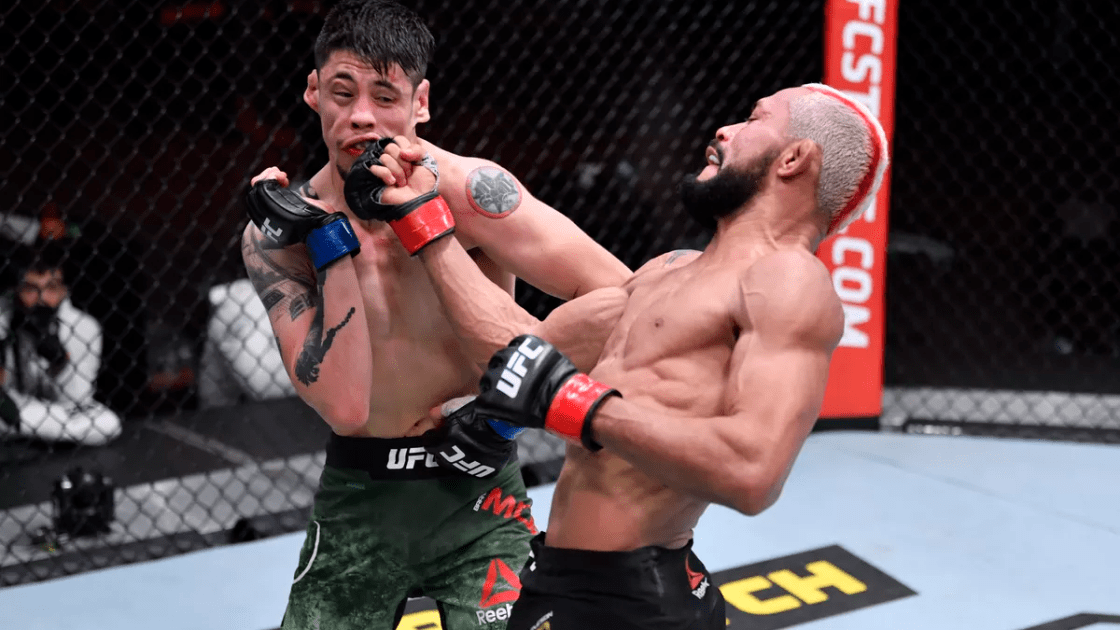
Last Saturday, Figueiredo met No. 1 contender Brandon Moreno in the biggest possible fight the flyweight division had on offer. Figueiredo, the breakthrough MMA superstar of 2020, was looking to cap off a year where he had emerged as the sport’s new King of Violence. And Moreno, a tough and exciting young star who had once been a victim of the 2018 flyweight purge. What followed may have been the single greatest fight in the history of flyweight mixed martial arts, and a shortlist contender for Fight of the Year.
Moreno’s performance had to be seen to be believed. Battling through an injured eye, an injured shoulder, a weird lump on his left forearm that Joe Rogan repeatedly insisted was a broken arm, and with possibly the most powerful flyweight in history smashing him in the head with cinderblocks for 25 minutes, Moreno never went down. The challenger fought the fight of his life, eating everything that Figueiredo threw, never letting up on the pressure and forcing the champion into deeper waters than he had ever been in.
Moreno’s output at times outpaced the champion’s, who seemed a bit befuddled at how the challenger was surviving all this punishment. Throughout the fight, Figueiredo landed the most powerful shots, but Moreno hardly flinched. Moreno tested Figueiredo’s chin himself, turning the title bout into an all-out war that captivated for all five rounds.
In the end, the quality of Figueiredo’s blows proved the difference, and the Brazilian walked away still champion via a majority draw – Figueiredo would have won a unanimous decision had he not been docked a point in Round 3 over a particularly hard kick to the groin. But the draw cleanly sets up a rematch for 2021, one that will likely be the single most anticipated flyweight fight in history.
With the first fight’s wild action, it seems impossible for the rematch to live up to it. It doesn’t have to. Saturday’s fight has gone a long way towards reviving interest in the 125-pound division, and all of a sudden UFC flyweights are looking in a better spot than ever.
Figueiredo is a big-time star in the making. The only thing keeping him from becoming a household name might be the fact that the name in question is too hard to spell. The champion is colorful, distinctive, in his prime, and has a penchant for producing violent moments and amazing highlights. He’s main-evented two straight UFC pay-per-views, and in the last few months of the year he’s felt like one of the protagonists of the UFC. He’s become must-watch over the course of 2020, and seeing how far he’ll go is one of the most fascinating storylines in the UFC.
And most of the division’s top contenders are young and on the rise. Moreno is 27. Alex Perez, who challenged Figueiredo last, is 28. The undefeated Askar Askarov is 28. The ultra-exciting Brandon Royval is 28. Alexandre Pantoja, Rogerio Bontorin, Kai Kara-France, Matt Schnell, Raulian Paiva – none of them are older than 30. Former RIZIN champ Manel Kape, an absolute killer, is soon to debut. Cody Garbrandt still may come down from 135 and add some spice. There are endless amounts of interesting matchups that could carry the division for years – if the UFC is really interested in properly promoting them.
But for the first time in a long time, we aren’t talking about the UFC flyweight division in terms of whether or not it will survive. Instead, we’re excited for its future. We have Figueiredo and Moreno to thank for that. I can’t wait for the rematch.
 The Big Fight