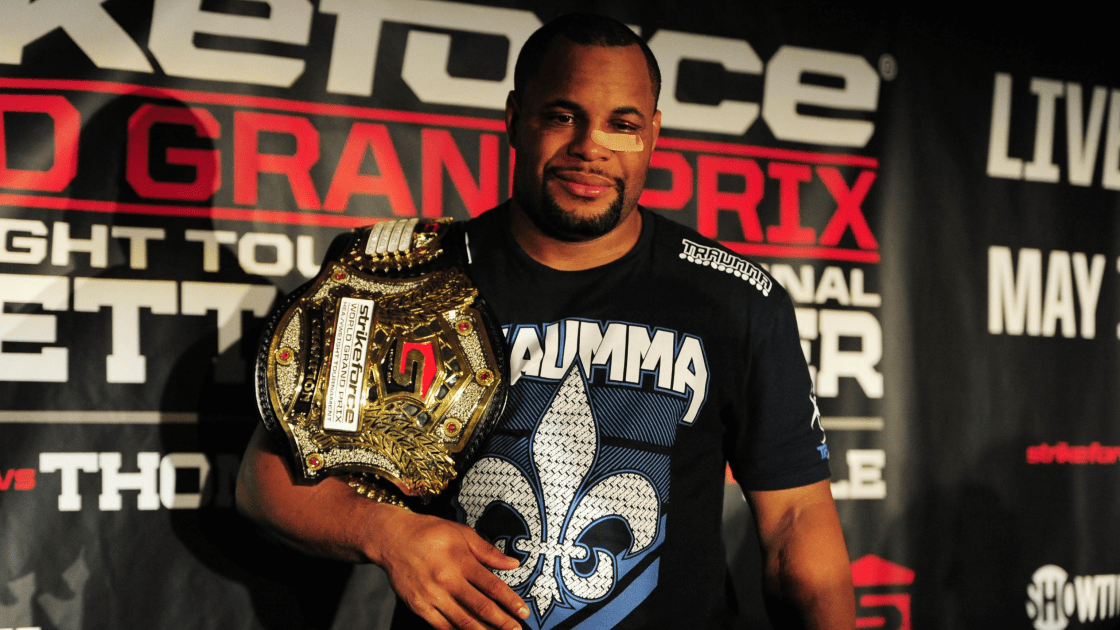
Fans of Daniel Cormier have watched him and supported him through a career filled with triumph and tribulation. And as one of MMA’s all-time greats officially hangs it up this week, most of the retrospectives on his career have focused on his greatest achievement: holding two UFC championships at once.
But my thoughts drifted back a little bit earlier. I couldn’t help but go back to the fall of 2011, when we truly realized that an undersized wrestler from Louisiana was a once-in-a-generation talent.
So on this week’s edition of the Big Fight Rewatch, I’m turning the clock back to Sep. 10, 2011, and the semifinals of Strikeforce’s hyped Heavyweight Grand Prix in Cincinnati. The opponent is Antonio “Bigfoot” Silva, an overpowering Brazilian karate fighter with hands the size of baseball mitts. The beatdown is one of the most stunning I’ve ever watched.
By 2011, Cormier had started to emerge as one of heavyweight MMA’s brightest prospects, but his name recognition was dwarfed by the other fighters in the Grand Prix. If you followed NCAA and Olympic wrestling, you probably knew who Daniel Cormier was, but as an MMA fighter, he was easily the least known of the group. There was Fedor Emelianenko, regarded as the greatest heavyweight of all time; two UFC champions, Josh Barnett and Andrei Arlovski; Fabricio Werdum, who had become the first man ever to cleanly beat Fedor the year before; a pair of elite strikers and long-time Pride veterans in Alistair Overeem and Sergei Kharitonov; and then Silva and Brett Rogers, two fighters with much more primetime experience than Cormier.
That tournament – which garnered a ton of buzz at its outset – was considered so stacked that Cormier didn’t even make the initial bracket. Instead, Cormier had to beat Jeff Monson, a 40-year-old UFC veteran more known for his anarcho-communist politics than his fighting ability, just to get the right to call himself an alternate for the competition. Most expected the Grand Prix to be another coronation for Fedor, or possibly Overeem, who had looked like one of the world’s most dangerous men since departing Pride. Few thought that it would instead launch a completely new star entirely.
Cormier got his chance when Overeem surprisingly dropped out of the tournament after beating Werdum, stating that the July-September turnaround between the quarterfinals and semifinals was too quick. Those in the know had high hopes for DC, but he was still a major underdog against Bigfoot Silva, who had truly made his name in the quarterfinals, kicking Fedor’s ass in a way that few had ever conceived of seeing.
The win launched Bigfoot’s stock through the roof, and instantly made him one of the expected favorites to take the whole tournament. But, as it turns out, Silva was drawn against another all-time great in the semifinals – we just didn’t know it yet.
(Cormier wasn’t the only future legend fighting that night in Cincinnati, by the way. The undercard had a then-unknown Amanda Nunes, in just her eighth pro fight, years before she became the greatest female fighter who ever lived. Yoel Romero, one of the best fighters to never win a belt, ate the first loss of his career against the heavy-handed Rafael Feijao, whose fights I used to love watching. And the main event featured Luke Rockhold, the future UFC middleweight champ, outpointing Ronaldo “Jacare” Souza to claim the first great victory of his career.)
Cormier put Silva on notice within the first minute, dropping the Brazilian with a massive overhand right, then let him back onto the feet for more punishment. It became evident immediately that Silva wanted nothing to do with Cormier on the feet, but DC never took the bait – he kept blasting Silva with shots and then letting him back up, giving Bigfoot no choice. At one point, Silva tries a kick to Cormier’s side – DC catches it, sweeps the other leg, and then just stands over him.
You know what watching that sweep feels like? It feels like Daniel Cormier is the sensei of the dojo, and he’s rebuking and humiliating a boastful young student. How absolutely demoralizing does that have to be? You’re Antonio “Bigfoot” Silva – you just dominated the undisputed heavyweight GOAT. Now, this guy who barely anyone has heard of is laughing at everything you try to do.
Chastened, Silva moves forward and tries to pin Cormier down with a few combinations against the cage. Cormier slips away untouched. Silva tries another kick – Cormier catches it, ducks a right hook, then tags Silva with a left. It’s time for this farce to be over. DC walks in, boops Bigfoot with an uppercut, and we’re done.
This fight is still relatively early in DC’s career, but it’s so cool to go back and see hints of the techniques that he used in the biggest fights of his career. You see flashes of the way DC boxed Stipe Miocic years later – walking him down, not afraid of punches flying his way, bringing his gloves high to grab his opponent’s hands and then slipping in some shots. You see the uppercut from in tight that sent Jon Jones’ mouthpiece flying. You see the subtle defensive movements DC was able to use throughout his career, to avoid withering punches from fighters who were almost always longer than he was.
But more than anything, you see the power that lent Cormier’s extremely technically sound boxing its malice. Cormier came into his career with world-class wrestling. That’s the one thing we all knew about him. Against Silva, he showed the world that he was so much more. He would dictate where he wanted the fight to go, and wherever that might be, he would be in control.
Daniel Cormier entered the Strikeforce Heavyweight Grand Prix as a prospect. He exited – after beating Silva and then Josh Barnett in the finals – as a star. To me, the Bigfoot fight was the first time I realized that DC was truly special. And as we bid farewell to Cormier as an active fighter, it’s the fight I want to go back and watch and rewatch the most.
Now, if you’ll excuse me, I’m gonna go watch that leg sweep another 20 times.
 The Big Fight