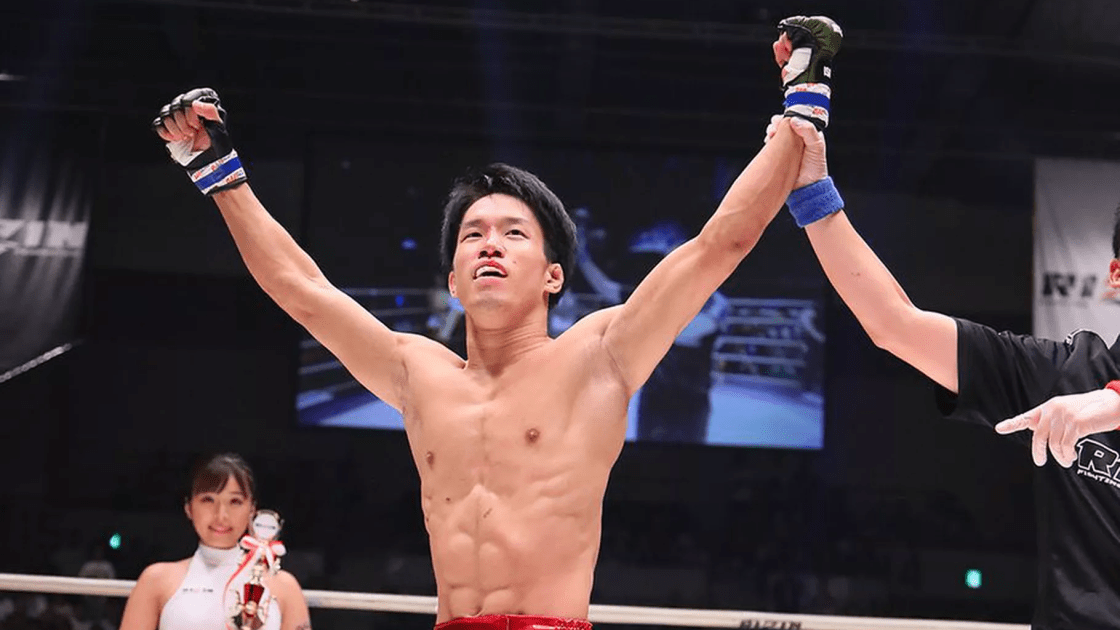
When Kai Asakura knocked out Kyoji Horiguchi in front of a sold-out Aichi Prefectural Gymnasium last August, it felt like a truly significant moment in the recent history of Japanese mixed martial arts.
You can pretty cleanly separate the sport’s history in Japan into two eras: Before Pride and After Pride. In the early- and mid-2000s, Pride Fighting Championships made mixed martial arts one of the most popular sports in the country, drawing as many as 91,000 fans to events in venues like the Tokyo Dome and the Tokyo National Stadium.
But Pride buckled under financial difficulties and accusations of yakuza ties in 2006, leading to its sale and merger with the UFC in 2007. The failure of the nation’s biggest MMA organization, and the societal stigma that came with the sport’s perceived link to the yakuza, dealt professional fighting a blow that it has not come close to recovering from.
In 2015, former Pride president Nobuyuki Sakakibara founded Rizin, a spiritual successor to Pride. Asakura debuted for the promotion in late 2017, and by the time his shot at the champion came last year, Asakura’s popularity had already been surging in his home country due to his remarkable personal story, his exciting style, and his social media presence.
And when he knocked out Horiguchi – a former UFC flyweight title challenger who was universally regarded as one of the best bantamweights in the world – it seemed that after more than a decade in the wilderness, Japanese MMA finally had a new superstar.
Rizin had hitched its hopes to Asakura as its new big money star before he ever reached true main-event status. Asakura and his older brother Mikuru – himself a very promising featherweight – grew up as delinquent street toughs in Aichi, known for frequently getting into fights. By his late teens the Asakura brothers had discovered MMA as an outlet, coming up in the sport through The Outsider, a promotion set up as a second chance for criminals, gang members and troubled youths.
But Kai Asakura seemed to have something a little different than the other rehabilitating rejects in The Outsider. He had extremely fast hands, shocking power, and a mental toughness honed in so many street fights. It’s no wonder his story has resonated so much with Japanese fans – his story is a dead ringer for one of Japan’s most popular and iconic mangas, Ashita no Joe, about a teenage hooligan who discovers boxing and becomes a champion.
Asakura turned professional full-time in 2015, and soon started knocking out all comers. He debuted with Rizin in 2017, quickly rocketing up the bantamweight ranks. As previously mentioned, he had his crowning moment last August, when he took just 68 seconds to dispatch Horiguchi in a non-title fight – at the time, Horiguchi held both the Rizin and Bellator bantamweight championships, was on a 13-fight win streak, and had a compelling argument as the No. 1 pound-for-pound fighter not signed to the UFC.
Asakura’s star was made. Two months later, he broke UFC veteran Ulka Sasaki’s jaw with a monstrous right hand, setting up a rematch with Horiguchi on New Year’s Eve for the bantamweight belt.
But not all stories go exactly to plan. Horiguchi pulled out of the rematch with a torn ACL and was replaced by Manel Kape, a very good Angolan striker who had given Asakura a very stiff test the previous May. The fight drew Rizin’s largest-ever crowd to one of Pride’s iconic venues, the Saitama Super Arena, but this time around Kape looked just a bit sharper on the feet, dropping Asakura with a right hand early in the second and finishing him with a follow-up flurry that stunned the crowd.
Asakura returned to the ring last week, restoring some of his lost hype by absolutely running through tough veteran Hiromasa Ougikubo in one of Rizin’s first post-COVID shows. It was an extremely impressive performance against a very challenging opponent, and it showcased all the best of Asakura’s sparkling potential.
But Kai Asakura doesn’t necessarily need to be the world’s best bantamweight to be the kind of star Rizin can build around. All he needs is to find some way to resonate with the Japanese fans, which he’s already done: he has a very popular YouTube channel with over 600,000 followers, and he’s continued to build up a groundswell of support among the sporting public.
Even at Pride’s peak, when the organization’s roster boasted many of the most legendary fighters in the history of the sport, the company relied on native Japanese names who had wider mainstream recognition to really drive business.
Look back at the biggest-drawing cards over Pride’s history. The main featured fighters generally weren’t guys like Fedor Emelianenko, Wanderlei Silva or Minotauro Nogueira, some of the greatest fighters on Earth at the time. They were homegrown stars like Kazushi Sakuraba, Nobuhiko Takada, Hidehiko Yoshida and Naoya Ogawa. All four were Japanese natives, and most had notoriety outside mixed martial arts: Takada was a huge drawing card as a professional wrestler during the 90s, while Yoshida and Ogawa were household names as Olympic medalists in judo.
What’s more, winning wasn’t always necessary for these guys to draw. Sakuraba, a truly pioneering grappler who became famous for his victories over members of the Gracie jiu-jitsu family, was the biggest drawing card in Pride’s history, but his goose was cooked as an elite fighter by 2003 at the absolute latest. Takada, who headlined Pride’s first-ever event in 1997, won only two of his nine pro fights, and at least one of those wins was basically confirmed to be worked. Yoshida was never a top-level fighter, while Ogawa was totally dominated by Emelianenko in his one shot at the heavyweight kingpin.
It’s been a long time since Japan has had someone like that, but so far, at least, Kai Asakura has shown the ability to put some butts in the seats. Kape is out of the way, having signed with the UFC not long after their fight, while an Asakura-Horiguchi rematch still looks like one that could drive some business.
Japanese MMA will almost definitely never return to the heights of Pride, with sold-out stadiums and a level of presentation and spectacle that’s still far ahead of any organization today. But all it takes is one big star to start the climb back. At just 26 years old, Kai Asakura has all the time in the world.
 The Big Fight