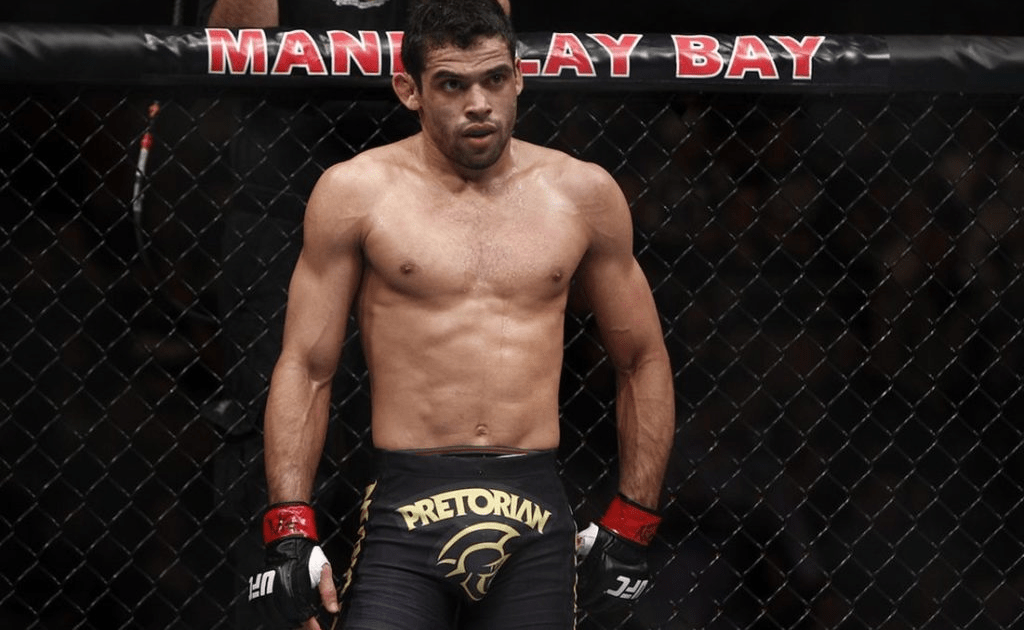
Last week, Brazilian promotion Taura MMA announced perhaps its biggest name signing ever. Taura has been in the news lately for signing a spate of well-known Brazilian UFC veterans, names like former heavyweight title challenger Antonio “Bigfoot” Silva and mentally insane heel hook machine Rousimar Palhares. But to headline the organization’s lower weight classes, Taura settled for no less than a one-time UFC champion, once one of the top pound-for-pound fighters in the world: Renan Barao.
Normally, you’d figure a former world champion signing with a relatively unknown promotion would earn some attention. It’s a testament to how far Barao has fallen, in such a short time, that it passed with almost no notice whatsoever.
There are few things sadder to watch than a fighter holding on too long, taking beating after beating while chasing renewed glory in the ring. Sad, for sure, but common in the fight business. The number of high-level fighters or boxers who retire at the right time isn’t that high. Usually, you wind up eating a few too many losses, taking a little bit too much head trauma, before you realize that it’s time to move on.
If I wanted to write about the decline and fall of a former champion, there’s 100 people I could choose from. But I wanted to write about Renan Barao because when I saw that he had signed with Taura MMA, I realized that I had totally forgotten he ever existed.
And how could that possibly be? Barao was a superstar. He was a killer who, at one point, had one of the most incredible records anyone had ever seen in MMA. And yet, no elite fighter has ever seemingly dropped off the face of the Earth in quite the same way he did.
It was so sudden, and at the same time, kind of quiet. One moment, Barao was ruling the bantamweight division with an iron fist and knocking out stars in the main event. Then, snap your fingers, he’s losing fight after fight on the early prelims to dudes without Wikipedia pages. And in this case, you can trace Barao’s decline to one specific night: May 24, 2014, when Barao absorbed one of the most epic, prolonged beatdowns in UFC history and lost his title to relatively unheralded challenger T.J. Dillashaw.
It’s hard to overstate how stunning the Dillashaw-Barao fight was at the time. For one, Dillashaw wasn’t even supposed to be Barao’s opponent. Barao was initially scheduled to fight tough veteran Raphael Assuncao, who was on a six-fight win streak. But Assuncao pulled out of the fight with a rib injury, and Dillashaw – whom Assuncao had beaten the previous October – was pulled from his scheduled fight with Takeya Mizugaki and moved up to the main event.
Barao was a massive betting favorite, and on one of the longest winning streaks in MMA history. He had just reached the peak of his career a few months before, when he knocked out one of the most bankable lighter-weight fighters ever, Urijah Faber, in the first round to defend his title for the third time. In the discussion of the top pound-for-pound fighters on Earth, Barao’s name was tossed around in the same stratosphere as guys like Jon Jones and Jose Aldo.
Dillashaw, on the other hand, was probably best known for reaching the bantamweight finals of The Ultimate Fighter 14, where he lost to future flyweight title challenger John Dodson. He was 9-2 in his pro career, and didn’t have any big-name wins on his record. At the time, Dillashaw was seen as a promising future prospect, but not ready for primetime yet.
Dillashaw’s win, naturally, was a huge upset. But what was truly shocking was how it happened: Dillashaw absolutely beat the piss out of Barao for over 22 minutes before finishing him midway through the fifth.
Few individual bouts have ever damaged a fighter’s career the way the Dillashaw fight damaged Barao’s. You can say it was at least partially due to, ahem, illegal substances – Dillashaw’s later two-year suspension for using EPO has tainted many of his accomplishments – but that doesn’t fully account for Dillashaw’s dominance. The American lopsidedly outstruck Barao throughout the evening, and Dillashaw’s later failed drug tests don’t make the damage to Barao’s body and soul any less real.
It might be cliche to say that Renan Barao was never the same after that night, but he truly never was the same. Barao was a terror before the Dillashaw fight, a jiu-jitsu black belt who seemed completely impervious to being taken down, and carried knockout power in both his hands. But what set Barao apart was a fantastic nose for the finish, an animal killer instinct. Barao was decisive when he sensed the opening, always seemed to be working to put the other guy away, and seemed to pull finishes out of places you didn’t expect.
After the Dillashaw fight, we rarely saw that Renan Barao again. Barao looked much more restrained in a submission win over Canadian Mitch Gagnon in December – it was unusual to see a fighter like Gagnon, not known for his striking, manage to survive standing in front of Barao for as long as he did. The win earned him a rematch with Dillashaw in July 2015, but the new champion handily outstruck Barao again and sent him packing in the fourth round.
From there, the bottom fell out for Renan Barao. He tried to move up to featherweight but lost his debut fight to perennial gatekeeper Jeremy Stephens. He tried to move back down to 135, but started having serious trouble with the weight cut, missing three times over the next three years. He lost five in a row starting in July 2017, and never again looked confident or sharp on the feet. After the fifth loss, a featherweight fight against Douglas Silva de Andrade last November, he was unceremoniously released by the UFC.
I think many people expected never to see Renan Barao again after his UFC release. And for most, he stopped really mattering after the defeat by Stephens in his move up to 145, or when he lost to rising contender Aljamain Sterling at the outset of his five-fight losing streak. Dillashaw had kicked his ass so comprehensively, over the course of nine total rounds, that his credibility as an elite fighter was gone.
Whatever the physical toll was caused by those two beatdowns, it never seemed like Barao was mentally the same fighter. And yet, he still seems to have the desire to fight – otherwise, he wouldn’t be trying to keep his career alive in an upstart promotion. I hope it works out for him, and that he’s able to end his career in a satisfying way. Like I said, there are few things tougher to watch than a fighter on the decline, trying desperately to stave off the passage of time.
 The Big Fight