The MMA Internet is, truly, one of the most harrowing places one could ever dare to tread. Dear reader, I started visiting the Sherdog.com forums when I was 12 years old so one day you wouldn’t have to. From a young age I was imbued with a powerful sense of duty, an inner drive to one day be a guardian, a silent protector, keeping the innocent safe from the terrors that are unleashed when dudes on the Internet gather to talk about fighting.
The darkest depths of the MMA Internet don’t quite descend into the depths of madness touched by, say, the Bodybuilding.com forums, where two men – presumably functioning citizens with lives and jobs – once argued for months about how many days there are in a week, but it can get pretty bad. Nothing of value is produced in those blasted lands, and everything you learn should be forgotten as soon as possible.
With all that in mind, let’s discuss the term “gatekeeper.” The gatekeeper is a role that fighters of a certain level tend to fall into: better than 90% of the riffraff but not quite good enough to win a title or beat a top contender, they settle into lives in the upper midcard, usually serving as the test for rising prospects who have reached a point where they’re on the cusp of being major players.
If you read MMA Internet comment sections, the cancerous oafs who post there might give you the false impression that “gatekeeper” is an insult. If you express an admiration for a fighter who has been around a while but hasn’t won a championship, prepare to have the “gatekeeper” term leveled at you: to many, it’s a dismissal of that fighter. They aren’t good enough to be No. 1, so that means they suck.
Not only is that attitude insulting to many skilled and talented fighters, men and women who destroy their brains for our entertainment and not enough money, it’s inaccurate. The gatekeeper is one of the most important roles one can find themselves in, it provides important long-term stability in a business where fighters are churned through like butter, and it requires someone who’s pretty damn good.
While being a gatekeeper might imply that you’re never going to be one of the main attractions, a gatekeeper has to still be one of the best fighters in a promotion: they have to pose a threat to a division’s brightest talents. Fights with a gatekeeper are imbued with importance. If you win, you’re legit.
One can easily find out who the gatekeepers in each UFC division are by looking through the records of the top contenders, and looking for commonalities. You’ll see guys like welterweight Neil Magny, a grinding wrestler who will ruin the day of anyone who can’t keep their backs off the cage. There’s lightweight Edson Barboza, a Muay Thai god who has taken the soul of many an unprepared fighter who still needs to work on his standup. Former kickboxing world champion and walk-off KO artist Mark Hunt served in the same role at heavyweight for years, until he got old and his once-fabled chin started to fail him.
All strong fighters, all fringe top-10 guys for years, all deserving of respect. But the reason why I’m writing about this specific topic right now is UFC middleweight Derek Brunson.
Brunson and fellow 185 gatekeeper Brad Tavares have served as a tag team for several years: a sort of Ornstein and Smough of the UFC middleweight division. (Brunson is Smough, just by virtue of the fact that the vast majority of players kill Ornstein first, but you’ll get a special item if you kill Smough first.)
Beating Tavares means that you’re probably ready to enter the top 15 and really start looking upward. Beating Brunson means that you’re ready for fights with the division’s elite. Robert Whittaker beat Tavares and then Brunson during his rise to UFC middleweight gold. Ditto the current champ, Israel Adesanya.
Last weekend, quick-finish specialist Edmen Shahbazyan was the latest to attempt to to complete that two-step. Shahbazyan obliterated Tavares with a first-round head kick last November, and stepped into the ring with Brunson in order to vault himself to the tippy-top.
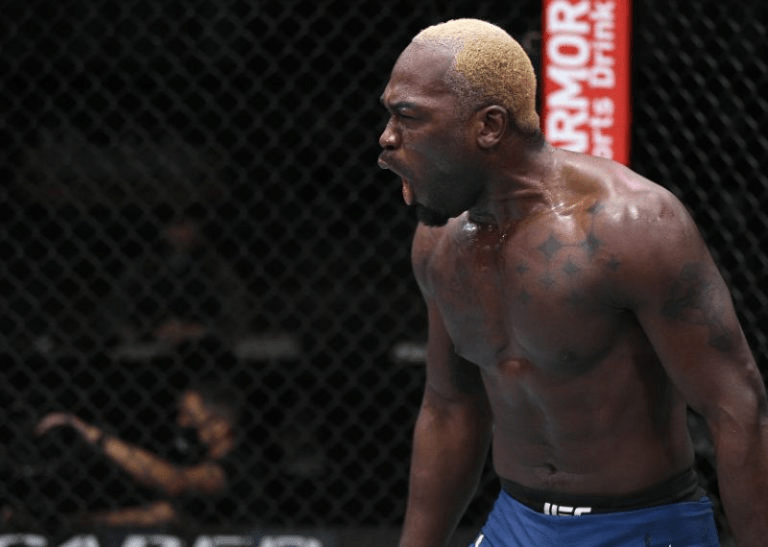
But then something funny happened: Brunson beat his ass! Brunson forced Shahbazyan – who had hidden his questionable cardio by just knocking everyone out in a minute – to defend takedowns and deal with someone strong and aggressive. The 22-year-old gassed out badly midway through the second round, and Brunson’s vicious ground-and-pound led to a TKO win early in the third.
It was a reminder that even though Brunson has been slotted into that gatekeeper role, he’s still a damn good fighter, and getting better. Brunson is a fantastic gatekeeper because he’s an excellent athlete, a former All-American wrestler with heavy hands, good boxing skills and an aggressive mindset. You have to mind your P’s and Q’s if you’re gonna beat Derek Brunson – otherwise, he can put you on your back and pound your face in.
But on Saturday, we saw one of the best versions of Derek Brunson we’ve maybe ever seen. His ugly tendency to charge at guys with his chin up didn’t appear, and his once-spotty gas tank has looked much improved. Brunson has looked to have possibly turned a corner during his recent three-fight winning streak, where he also spoiled hot runs from Elias Theodorou and Ian Heinisch.
Maybe it has something to do with his new bleached blond hair, which brings to mind memories of a former UFC champion, the late Kevin Randleman. But Brunson’s recent hot streak, and his dismantling of the hyped Shahbazyan, is making many reconsider their opinions of him.
In a sense, maybe being a gatekeeper has been one of the best things for him. being a gatekeeper means you have a more stable role in a promotion, and it means that you can continue to get reps at a high level. Brunson’s win on Saturday came in his 16th UFC fight. That’s a lot of chances to gain experience, figure out your weaknesses and find a groove.
And sometimes, guys like that can come out of nowhere and become real contenders themselves. Look no further than fellow middleweight Michael Bisping, who served in the same role that Brunson did in the same division years ago.
After winning The Ultimate Fighter 3 in 2006, Bisping settled in at the level of really good, not great: losses to guys like Dan Henderson, Wanderlei Silva and Chael Sonnen spoiled any chances at earning a title shot. Over time, he became the top gatekeeper at 185, and ascending fighters like Tim Kennedy and Luke Rockhold successfully passed through the Bisping Gate in the early 2010s.
But Bisping kept fighting, kept winning just enough, and in 2016, a win over declining former pound-for-pound king Anderson Silva proved enough to get him a shot at Rockhold, now the middleweight champ.
And two years after Rockhold cleared the Bisping Gate, the sharp-tongued Englishman knocked his ass out and became a champion in his 25th UFC fight.
Bisping’s title win was, and still is, an incredible story. But four years later, it still serves as a public service announcement for Brunson, and others.
Don’t underestimate your gatekeeper. Don’t forget them. They’re there for a reason, and that reason isn’t just to serve as a speed bump for guys on the way up. They’re there because they can win fights too, and if a few things go right, someone like Derek Brunson might be only a couple wins away from making a run of their own – no matter what the MMA Internet says.
 The Big Fight